

EMPOWERING PATIENT CARE EXPERIENCE
Hospital de Cascais I Portugal
Home-Based Hospital Care
Hospital de Cascais’s Hospital-at-Home Unit provides eligible patients with hospital-level care in their own homes, supported by multidisciplinary teams and coordinated referral pathways. Since launching in 2023, the service has expanded from 5 beds toward a capacity of 35, offering a more comfortable, personalised alternative while maintaining strong clinical safety and quality. Results include shorter average stays than conventional hospitalisation, lower mortality and readmission rates, higher patient satisfaction, and estimated savings of €600,000 in 2025. The project is also developing digital tools for bedside documentation, medication safety, remote monitoring and route planning to support the model’s continued growth.
EXCELLENCE IN HEALTH TECH INNOVATION AND AI INTEGRATION
Hospital San Juan de Dios de León I Spain
AI-Assisted Precision Spine Surgery
Hospital San Juan de Dios de León combines AI-assisted surgical planning, patient-specific 3D models and guides, robotic intraoperative CT, and surgical navigation to support complex spinal surgery. The technologies help surgeons plan and place implants with greater precision, tailoring each procedure to the patient’s anatomy. More than 1,600 patients have benefited from navigation and over 250 from personalized models and guides, with implant placement accuracy exceeding 99% and intraoperative radiation reduced by up to 90%. The approach also shortens planning time and could be adapted to other complex surgical specialties.
INNOVATION IN PREVENTIVE CARE AND COMMUNITY OUTREACH
Recoletas Salud I Spain
Vital Pulse – Community-Based Stroke Prevention
Vital Pulse brings free, 30-second ECG screening to 64 health points across 61 municipalities in Zamora, making cardiovascular prevention more accessible, especially for people in rural areas. The programme aims to detect atrial fibrillation early, a condition linked to more than 30% of strokes, and connect people with potential abnormalities to cardiology specialists through telemedicine. Since launching in 2022, it has performed over 58,400 ECGs and identified 1,315 cases of atrial fibrillation, including cases in people without symptoms. Its next phase, Vital Pulse 2.0, adds AI and advanced data analysis to strengthen risk detection and preventive care.
EXCELLENCE IN PROFESSIONAL DEVELOPMENT
Lusíadas Saúde Group I Portugal
From Data to Professional Excellence –Data-Driven Healthcare Culture
Lusíadas Saúde’s digital clinical intelligence platform brings validated quality, safety and operational data into interactive dashboards, helping healthcare teams identify gaps and guide improvement. It supports continuous learning and benchmarking across the hospital network, covering areas from surgery and infection prevention to oncology and neonatal care. The platform has expanded from 32 to 118 indicators, while average monthly use has more than doubled, from about 170 to 372 accesses. Dashboard-supported initiatives have included raising discharge-note completion from 18% to 91% and pre-operative anaesthesia consultation compliance from 85% to 92.9%.
THE POWER OF COOPERATION
Asklepios Kliniken GmbH & Co. KGaA I Germany
VirtualWard
VirtualWard is a hospital-at-home model that enables selected nursing-home residents to receive hospital-level treatment in familiar surroundings after emergency assessment and stabilisation. The hospital retains clinical and legal responsibility, providing continuous remote monitoring, at least daily video rounds, nursing support and a 24/7 escalation pathway. By replacing suitable inpatient stays, the model aims to reduce transfers and hospital-related stress while freeing up beds; early implementation across two hospitals has treated a growing number of patients. A controlled evaluation involving 424 patients is assessing safety, length of stay, patient outcomes, resource use and costs.
SUSTAINABLE AND GREEN PRACTICES IN HOSPITALS
CUF – Hospitals and Clinics I Portugal
Sustainable Hospital – CUF Leiria
CUF Leiria Hospital was designed as an integrated sustainability ecosystem, combining energy-efficient architecture, renewable energy, water reuse, smart monitoring, waste reduction and eco-friendly operating-room practices. It is Portugal’s first and only hospital building to hold both an A+ energy rating and a Class A Building Automation and Control System (BACS) certification. Solar panels are designed to supply around 40% of the hospital’s energy needs, while treated rainwater and greywater are reused for irrigation and other non-potable uses. The project aims to reduce the hospital’s environmental footprint while providing a comfortable, human-centred care environment.
EXCELLENCE IN HOSPITAL ARCHITECTURE
CUF – Hospitals and Clinics I Portugal
CUF Leiria – A New Standard in Hospital Architecture
CUF Leiria Hospital is a new 22,112 m² facility designed to bring advanced, integrated healthcare closer to communities in Portugal’s Central Region. Its patient-centred design combines clear clinical pathways, accessible spaces, natural light and landscape integration with smart systems that support safety and operational efficiency. The hospital is Portugal’s only facility to hold both an A+ energy rating and Class A Building Automation and Control Systems certification; solar panels are expected to supply around 40% of its energy needs. Rainwater harvesting and greywater reuse further reduce demand for drinking water, making sustainability a core part of the hospital’s design and operation.
HAI PREVENTION AND GOOD CLINICAL PRACTICE
Clinique de TOGA I France
Boosting Vaccination Among Healthcare Professionals
Clinique de TOGA introduced a multidisciplinary, staff-focused campaign to improve influenza vaccination uptake and reduce the risk of healthcare-associated infections. The initiative addressed concerns and practical barriers through team discussions, tailored information, individual support and easier access to vaccination within departments. Coverage rose from 30.6% in 2024 to 93.8% in 2025, and no influenza outbreak occurred at the clinic during the surveillance period. Patient education activities on influenza vaccination and hand hygiene extended the project’s focus on prevention across the facility.
EXCELLENCE IN ROBOTIC CARDIAC SURGERY
Kardiocentrum AGEL I Slovakia
Advancing Cardiac Surgery Through Robotics
Kardiocentrum AGEL Košice–Šaca established Slovakia’s first robotic cardiac surgery programme using the da Vinci Xi system. It began with minimally invasive coronary bypass surgery in 2023 and expanded in 2025 to selected intracardiac procedures through an ethics-approved clinical study, with expert proctoring and stepwise training for the local team. Across 81 procedures through July 2026, the programme reported no in-hospital deaths, strokes or conversions to sternotomy, with a median hospital stay of 4–5 days. The local team now performs the coronary procedures independently, and robotic cardiac surgery was added to Slovakia’s DRG reimbursement system in 2025.
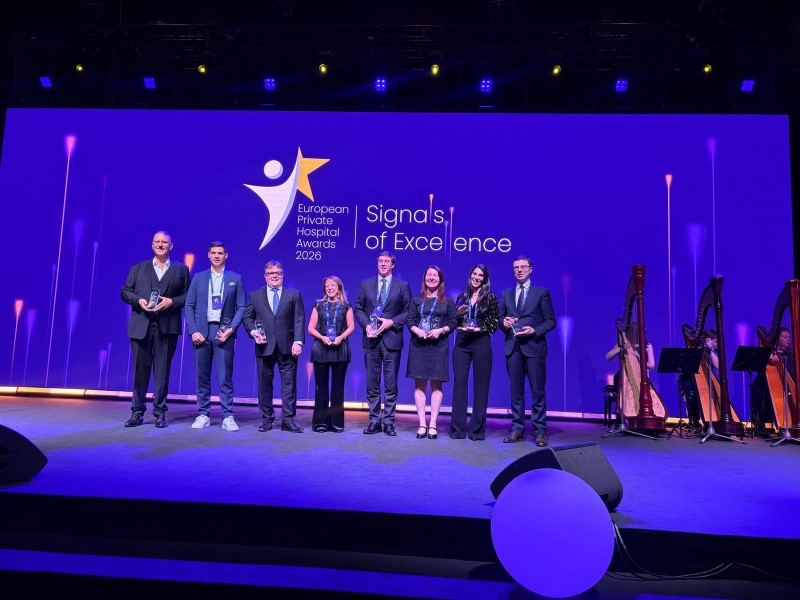
Congratulations to all this year’s winners! All projects demonstrate the commitment, expertise and creativity of private hospitals in improving patient care, embracing innovation, investing in healthcare professionals and building more sustainable health systems.
UEHP is proud to provide a European platform that showcases the value, dynamism and contribution of private hospitals to healthcare systems across Europe.